Administration issues alert over landslide fears in Rangamati

The monsoon is approaching. Moderate and heavy rains have already started in Rangamati. It has been raining intermittently for a few days. Due to the constant rain, there is a fear of landslides in Rangamati. In such a situation, the district administration has issued an alert in risky areas to avoid possible disasters. Warnings are being circulated regarding this.

The district administration said that the district administration has made all necessary preparations to deal with any disaster, including landslides, in Rangamati during the upcoming monsoon. Due to the rains for several days, panic has been created among the people living at the foot of the hills of Rangamati including the city. Landslides can happen at any moment. The district administration is issuing warnings and spreading awareness messages to ensure the safety of life and property of those living at the foot of the hills. The administration is asking people at risk to immediately leave the risky areas and take shelter in safe places if the amount of rain increases.

Meanwhile, Deputy Director of Rangamati Local Government Department Md. Mobarak Hossain inspected the risky areas of the district town. The district administration said that locals have been warned since May 22.

District Deputy Collector (NDC) Nabil Nowroz Boishakh said that the administration is conducting an advance warning campaign among those living at the foot of the hills to avoid loss of life and property due to increased rainfall in Rangamati. Such warning activities will continue if the rain continues. However, shelter centers will be opened if the rain persists for a long period.

Deputy Commissioner Md. Habib Ullah said that the utmost importance is being given to ensuring that no life is lost in any natural disaster, including landslides, in Rangamati. Therefore, instructions have been given to prepare for any possible natural disaster in Rangamati.

It is worth noting that on June 13, 2017, a terrible landslide in the district claimed the lives of 120 people, including 5 army personnel. In June 2018, another landslide in Naniarchar upazila of the district claimed the lives of 11 people, including 2 children, and in June 2019, three people were killed in Kaptai of the district.

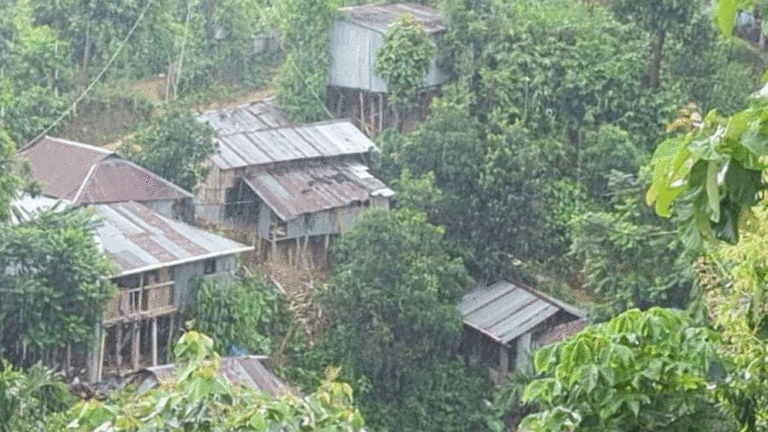
Meanwhile, Bhedbhedi, Shimultali, Rupnagar, and Jubo Unnayan area are among the 31 places identified as landslide-prone areas in the district town. Yet, surprisingly, the population in those areas is increasing. However, the scars of the 2017 landslide are still visible. Even then, people are living in landslide-prone areas. Despite knowing the risk of death, people are living on the slopes of the mountains. Risky settlements have been formed.

According to district administration sources, about 20,000 people from 5,000 families in the district are living at risk of landslides. 31 points in the city alone have been identified as risky. Many families are living at risk of landslides on the slopes and foothills of mountains in the city and in various upazilas of the district. The district administration has taken preparatory steps to deal with possible disasters including landslides in the district. Various authorities including the district administration, municipality, fire service, voluntary organizations have been asked to be ready. Upazila executive officers have been asked to take all necessary measures for the safety of people in risky areas.




Bail denied to accused in Shahid Kanya rape case, DNA test allowed

The court has rejected the bail of the accused in the controversial Patuakhali Shahidkanya rape case. At the same time, the court has allowed a DNA test of the accused teenager.


Judge Nilufar Shirin of the Patuakhali Women and Children Repression Prevention Tribunal gave the order on Sunday.


The tribunal's Public Prosecutor (PP) Md. Ruhul Amin Sikder confirmed the order. The hearing has been rescheduled for May 28.


Earlier, the investigating officer of the case, Dumki Police Station Police Inspector (Investigation) Md. Rafiqul Islam, applied to the court to conduct a DNA test of the accused Imran.


The investigating officer of the case, Md. Rafiqul Islam, told Jugantor that the court has given permission for a DNA test of one of the accused; but we have not received a copy of the order yet. Once we receive the copy, necessary action will be taken.


It is worth mentioning that on the evening of March 18, a teenager was gang-raped while returning to her grandmother's Algi village in the same union after visiting the grave of her father, who was martyred in the July Movement, in Ward No. 5 of Pangasia Union in Dumki Upazila of Patuakhali. Later, on April 26 at 9 pm, the teenager committed suicide at house No. B/70 on Road No. 6 of Shekhertek, Dhaka.


Jamaat calls emergency press conference

Bangladesh Jamaat-e-Islami has called an emergency press conference in the current situation in the country.

A press conference will be held at the Zahur Hossain Chowdhury Hall of the National Press Club at 12 noon on Tuesday. The party's Ameer Dr. Shafiqur Rahman will deliver an important speech.

Jamaat's Assistant Secretary General and Head of the Central Media and Publicity Department, Ehsanul Mahbub Zubair, confirmed this information on Monday.

Earlier on Saturday, the Bangladesh Jamaat Ameer held a meeting with the chief advisor. After the meeting, he told reporters, "We all demanded that there be meaningful reforms. A meaningful election will be held only through these reforms and justice."

He said that day, "We have said that two things need to be clarified. There must be acceptable reforms and there must be fair elections. We think that the announcement of the reform and electoral roadmap will remove a lot of doubts."


How India boosted the image of the Pakistan Army by attacking

On May 9, 2023, thousands of people took to the streets in major cities in Pakistan. They even targeted government and private institutions, especially those associated with Pakistan's powerful military, with attacks.

The targets included the army headquarters in Rawalpindi, the residence of a top military commander in Lahore (which was set on fire), and several other structures and monuments.

The protesters were mainly supporters of the Pakistan Tehreek-e-Insaf (PTI) and were protesting against the arrest of their leader and former Prime Minister Imran Khan.

Imran Khan was detained in the Islamabad High Court on corruption charges.

Although Imran Khan was released less than 48 hours later, the protests were seen as an unprecedented challenge to the military's rule.

The army has long been considered the most powerful and influential institution in Pakistan, maintaining authority in almost all areas.

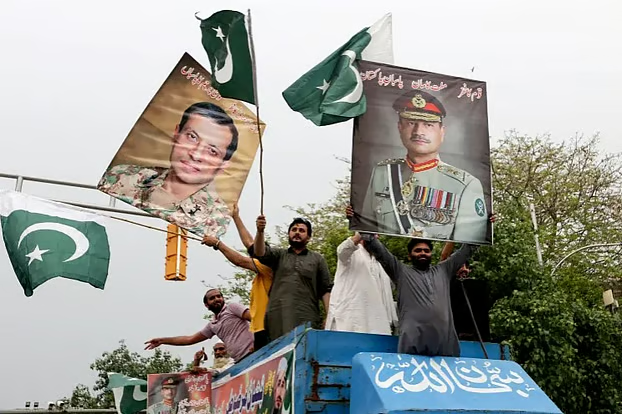
Exactly two years later, on May 11, 2025, thousands of people took to the streets again. But this time they took to the streets not against the military, but to praise and support them.

Last week, India and Pakistan engaged in a brief but intense military clash, with both sides attacking each other's installations.

Such a major conflict has not been seen between the two countries since the 1971 war.

The domestic impact of this near-war conflict on Pakistan is clear: public support for the army has increased sharply, and it is seen as the force that will protect the country from Indian aggression.

A Gallup Pakistan survey of more than 500 respondents from May 11 to 15, 2025, found that 96 percent believed Pakistan had won the conflict.

According to preliminary data and survey trends provided to Al Jazeera, 82 percent of people rated the military's performance as "very good." Less than 1 percent expressed dissatisfaction.

Most notably, 92 percent of people said that their perception of the military has become more positive because of this conflict.

Transition from 'Black Day' to 'Just War Day'

On May 11, the day after US President Donald Trump announced a ceasefire between India and Pakistan, people took to the streets in Pakistani cities with cars and motorcycles.

They waved the national flag and carried posters praising the army, especially the army chief, General Syed Asim Munir. There was a sense of joy and relief in the air.

For the previous four days, Pakistan had been engaged in a tense military conflict with its arch-rival India.

Two weeks after 26 civilians were killed by armed attackers in Pahalgam, Indian-administered Kashmir, on May 7, India launched missile strikes on various locations in Pakistan-administered Kashmir and Pakistan's Punjab province, blaming Islamabad for the attack.

At least 51 people were killed, including 11 soldiers and several children.

Over the next three days, the two nuclear-armed countries fired missiles, drones, and artillery at each other, bringing the subcontinent's 1.6 billion people to the brink of all-out war.


Industrial use of groundwater will have to be priced: Environmental Advisor

Syeda Rizwana Hasan, advisor to the interim government's Ministry of Environment, Forests and Climate Change and the Ministry of Water Resources, said, "Industries will have to pay a price for using groundwater. This measure is being taken to control pollution of reservoirs and rivers and to force reuse of water used by industries."

Syeda Rizwana Hasan, the chief guest at the 'River and Wetlands Symposium 2025' event at the PTI auditorium in Gazipur city on Saturday evening, said this. The advisor also said, 'We will sign an agreement to de-encroach and de-pollute four rivers of Dhaka and give an action plan. Because, we cannot do these in our time. However, the restoration of the Turag River will start within our time.'

At the beginning of the program, chaired by Gazipur Deputy Commissioner Nafisa Arefin, Bangladesh River Foundation Chairman Muhammad Monir Hossain presented an article on rivers.

The speakers at the event said that several other small rivers and streams flow through Gazipur, including the old Brahmaputra, Shitalakshya, Banar, Chilai, Luandaha, Shaldah, Goyali, Turag, Banshi, Balu, Goallar, Paruli. There are also several freshwater reservoirs including the beautiful Bolai and Moksh Beel. Despite being devastated by encroachment and pollution, these rivers and reservoirs are still influencing the society and culture of not only their own districts but also the surrounding areas. Research has shown that the quality of water in this district is declining. In some places, the amount of dissolved oxygen in water is even going to zero. River pollution is entirely responsible for this. Today's event is very important to find a way to protect rivers and wetlands to overcome this situation.

Sixteen proposals were presented from the Rivers and Wetlands Symposium. Speakers called for effective action on them.

The event was attended by special guests including Dhaka University of Engineering and Technology Vice Chancellor Mohammad Joynal Abedin, Gazipur Development Authority Chairman Mohammad Abdul Mannan, Gazipur Metropolitan Police Additional Commissioner Mohammad Zahidul Hasan, Gazipur District Police Superintendent Chowdhury Md. Jaber Sadek, among others.


Why is the BJP government waging this 'all-out war' against the Maoists?

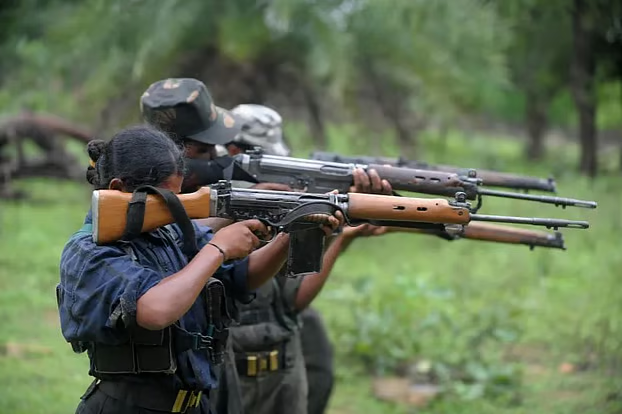
The military operation launched by the central and state governments against Maoist rebels in the Indian state of Chhattisgarh has practically become a battlefield. More than 10,000 troops have been deployed in the Karigatta hill forests of the state. Searches are being carried out in the deep forest areas with helicopters. This operation, known as 'Operation Zero' or 'Operation Kagar', is being considered the biggest step in suppressing Maoists.

The operation is being directly led by India's ruling Hindutva BJP government. They are in power at both the state and central levels in Chhattisgarh. The government has intensified its crackdown on Maoists since the beginning of this year. At least 201 rebels have been killed. Many of those killed are tribals. On Wednesday alone, 27 people died, including the last general secretary of the Maoist organization, Nambala Keshava Rao.

However, human rights groups and opposition parties have expressed deep concern over the operation. They allege that many innocent tribals are also being killed under the guise of 'Maoists'. They have called on the government to stop the fighting and hold talks.

According to government data, more than 11,000 people, including civilians and members of the security forces, were killed in Maoist conflicts between 2000 and 2024. Of these, at least 6,160 were rebels.

Who are the Maoists and what do they want?

The armed Maoist movement in India began in 1967 with a peasant uprising in Naxalbari, West Bengal. This 'Naxal' movement was led by Charu Majumdar, Kanu Sanyal, etc. Their demand was that land should be given to landless farmers and action should be taken against the exploitation of landlords.

This movement gave rise to the Communist Party of India (Marxist-Leninist), which believed in armed rebellion beyond the democratic process. The revolutionary philosophy of Chinese leader Mao Zedong was their main inspiration. However, over time, this party broke into many parts. The original CPI(ML) is now a formal political party. They participate in elections.

BJP's aggressive strategy

During the Congress government in Chhattisgarh (2020-2023), 141 rebels were killed. But after the BJP government came to power, the number of deaths rose to 223 in 2024. State Chief Minister Bishnu Dev Sai says, 'Now the final phase is underway, we are rapidly moving towards a Naxal-free India.'

Union Home Minister Amit Shah is also regularly visiting the field to support this campaign, spending nights in army camps. He has announced that India will be made 'Naxal-free' by March 31, 2026.

Currently, there are 320 government security camps in the Bastar region alone. There are about 3 million security personnel in the camps. More than 66,000 security personnel are deployed in the entire state of Chhattisgarh. Surveillance is being carried out in the dense forests through various modern technologies including drones, thermal imaging, satellite monitoring.

Allegation: Killing of tribals in fake encounters

But the most serious question about the operation has been about human rights violations. According to the People's Union for Civil Liberties, there has been evidence of at least 11 fake encounters in the past year and a half. For example, in March, the police claimed to have shot dead three rebels in Bordga village in Bijapur district. But locals say the three were picked up at night, shot and branded as 'Maoists'.

In 2012, 17 tribals were killed by security forces in the village of Sadek Guda and in 2013, 8 tribals. In the subsequent investigation, the High Court judges said that all the deceased were innocent. Yet, to this day, no case has been filed against any police officer.

Is the Maoists' capabilities diminishing?

In 2011, the then Inspector General of Police of Chhattisgarh, Vishwaranjan, estimated that around 10,000 armed Maoists and 40,000 militia members were active in the Bastar region. Although these numbers are difficult to determine with precision, the Maoists were capable of carrying out deadly attacks on security forces at that time. In 2010, they ambushed a forested area in Chhattisgarh and killed 76 paramilitary personnel. Three years later, another attack killed many people, including a Congress leader.

Currently, Bastar IGP Sundarraj P says that there are about 1,000 armed Maoists and another 15,000 people associated with them who are active.

Internal Maoist reports admit that their membership has dwindled. Units have become smaller and ammunition is running out. Of the 40 members of the Central Committee and Politburo that once comprised them, only 18 are now free. All the rest have been arrested or killed.

The Maoists may have weakened in Chhattisgarh, but they are regaining influence in the neighboring state of Madhya Pradesh. Maoism is an ideology—it cannot be ended by force alone. Until a society free of economic inequality is created, this ideology can return in a new form.


US Embassy in Dhaka advises US citizens to be vigilant about protests

The US Embassy in Dhaka has advised US citizens to be vigilant due to protests across the country, including Dhaka, in response to the conflict in Gaza, Palestine.

The advice was given in a post on the US Embassy's website, Facebook page and X (formerly Twitter) handle in Dhaka on Monday.

The post said that there could be a day-long protest today, Monday (April 7, 2025). University students are planning to participate in mass demonstrations and protests across the country, including Dhaka, in response to the conflict in Gaza. The US Embassy in Dhaka will limit its services in the afternoon today, Monday (April 7) due to possible traffic congestion and protest rallies towards the embassy.


Results of oral examination for two Metrorail posts published

The results of the oral examination for the positions of Ticket Machine Operator and Customer Relations Assistant of the 100% government-owned Dhaka Mass Transit Company Limited (DMTCL) have been published. 139 candidates have passed the Ticket Machine Operator and 63 candidates have passed the Customer Relations Assistant positions.

Candidates who pass the oral examination will have to collect their appointment letters from DMTCL's Diabari office on February 10. The results of the oral examination will also be communicated to the successful candidates through SMS.


Government employee hospital written exam schedule for 191 posts published

The written examination schedule for the recruitment of 191 vacant posts of 36 categories in the 11th-20th grade in the Government Employees Hospital has been published. This information was given in a notification by the institution. The notification said that the written examination for 191 posts of 36 categories will be held on April 18 and May 2 and 16. The examination will be conducted at Eden Women's College in the capital.

The time and date of the written examination will also be communicated to the candidate through SMS on their mobile phone. To participate in the examination, visit this website


10 percent discount on air tickets for the New Year

Biman Bangladesh Airlines has announced a special discount on tickets for the new year. According to the announcement, passengers will get a 10 percent discount if they buy tickets from Biman's website and mobile apps.

Biman Bangladesh Airlines General Manager (Public Relations) Bosra Islam gave this information in a press release sent to the media on Sunday.